|
|
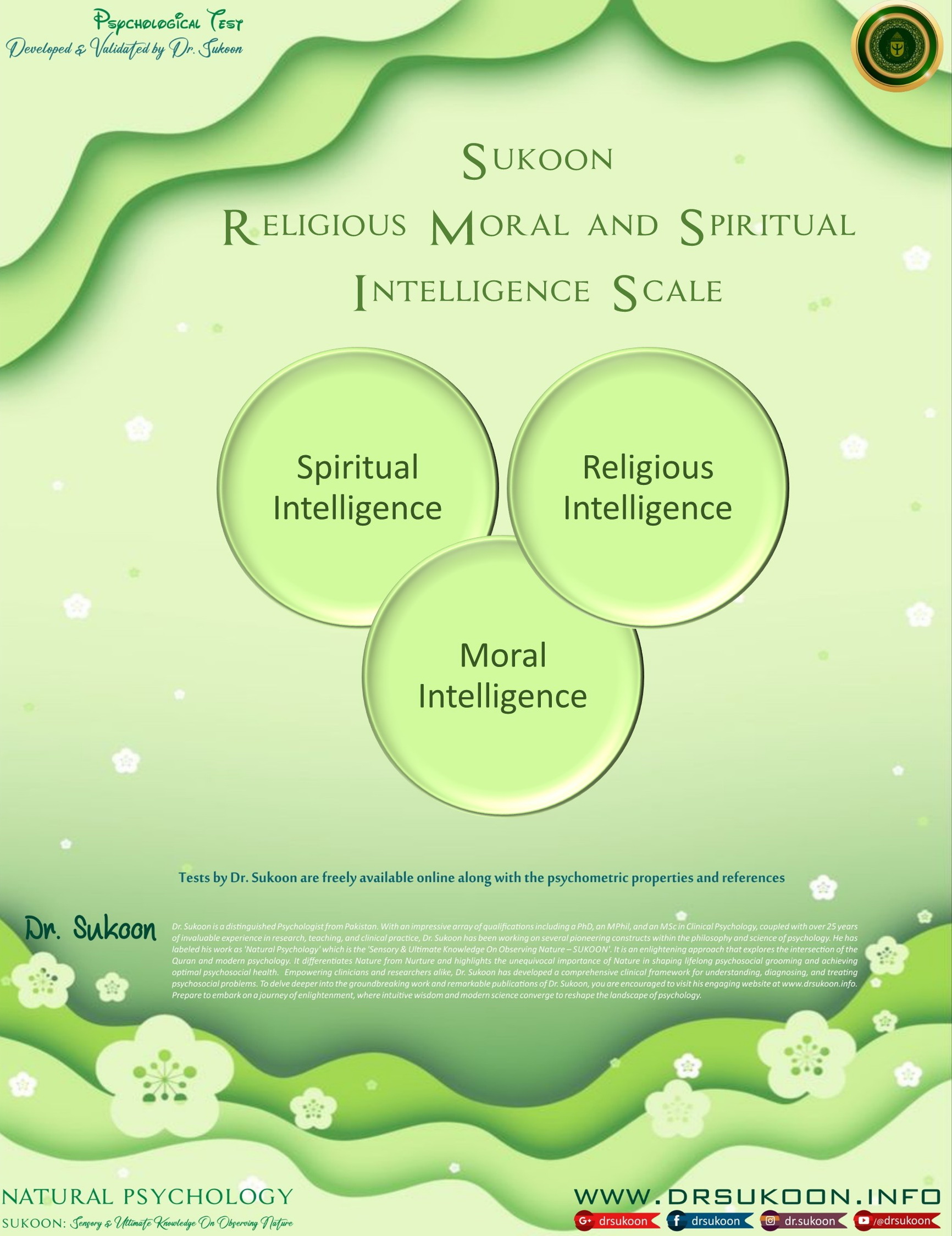
The Religious, Moral, and
Spiritual Intelligence Scales constitute a tripartite assessment
framework designed to measure three interrelated yet distinct
dimensions of transcendent and ethical cognition: religious
intelligence, moral intelligence, and spiritual intelligence. These
constructs, while often conflated in both popular and academic
discourse, are operationalized here with conceptual clarity and
psychometric specificity, allowing for a nuanced evaluation of how
individuals engage with belief systems, ethical discernment, and
transcendent awareness. Each scale is defined and measured as
follows:
Religious Intelligence – conceptualized as “the ability to validate
religious beliefs from the most authentic sources,” this scale
assesses individuals’ capacity to engage critically and
authentically with religious texts, doctrines, and traditions. It
reflects not merely rote adherence or dogma, but a reasoned and
source-based alignment with religious truth claims, emphasizing
epistemic integrity in religious belief formation.
Moral Intelligence – defined as “the ability to distinguish good
from bad based on humanistic virtues,” this subscale captures
ethical reasoning grounded in universal human values such as
empathy, justice, honesty, and compassion. It examines the cognitive
and affective processes through which individuals make moral
judgments and ethical decisions, independent of external authority
or cultural relativism.
Spiritual Intelligence – described as “the ability to feel and
experience the higher dimensions of mind,” this dimension taps into
a person’s capacity for transcendence, inner harmony, and
metaphysical insight. It includes sensitivity to existential
meaning, interconnectedness, and elevated states of consciousness,
reflecting the experiential and intuitive aspects of human
spirituality.
Together, these scales offer a groundbreaking framework for
assessing transcendental cognition and psychosocial development. By
distinguishing between religious, moral, and spiritual faculties,
the scales allow for the examination of their unique contributions
to identity formation, psychosocial health, and existential
wellbeing. This tripartite model holds substantial promise for
research in developmental psychology, philosophy of mind,
counseling, and interfaith education, especially in pluralistic
societies where diverse worldviews converge. The three scales thus
provide a valuable empirical tool for exploring the cognitive,
affective, and experiential dimensions of belief and value systems,
offering new insights into the role of transcendent intelligences in
human flourishing.
Instructions:
Please ensure that Scripts and ActiveX Controls are enabled in your
browser before proceeding with this electronic form.
Read each statement carefully and respond based on your immediate,
instinctive reaction. Trust your first impression.
Make sure to respond to every statement. Do not leave any item
unanswered.
This test generates your results instantly on the same page.
Therefore, do not change your responses once they are submitted, as
doing so would undermine the authenticity of your self-assessment
and reflect a lack of seriousness toward the process.
Your results are strictly confidential and cannot be accessed by
anyone else, including the administrators of this platform.
Please be honest and loyal to yourself throughout the test.
Once all items are completed, click the “Result” button to view your
scores. Interpretative guidelines are provided at the end of the
test.
Fill in the
following questionnaire |
|
|
|
Interpretation of Your
Result
20 to 80= Low on Religious, Moral, and Spiritual Intelligence
81 to 120 = Average on Religious, Moral, and Spiritual Intelligence
121 to 140 =
High on Religious, Moral, and Spiritual Intelligence
|
|