|
|
The SSS is a theoretically
grounded and psychometrically validated instrument developed to
assess the construct of selective sociality—a newly proposed
psychosocial skill that entails the intentional, mindful selection
of social engagements and digital interactions to promote
psychosocial health. As a response to the hyper-connected and often
overstimulating nature of the digital age, selective sociality
emphasizes the strategic management of interpersonal exposure as a
form of psychological self-regulation and wellbeing optimization.
This construct introduces a paradigm shift in the understanding of
social behavior, positioning intentional social selectivity not as a
sign of avoidance or introversion, but rather as an adaptive
psychosocial competence rooted in discernment, boundaries, and
internal wellbeing. In contrast to traditional measures of
sociability or social avoidance, the SSS captures how individuals
curate their social ecosystem to protect mental energy, regulate
emotional input, and cultivate meaningful connections. The scale
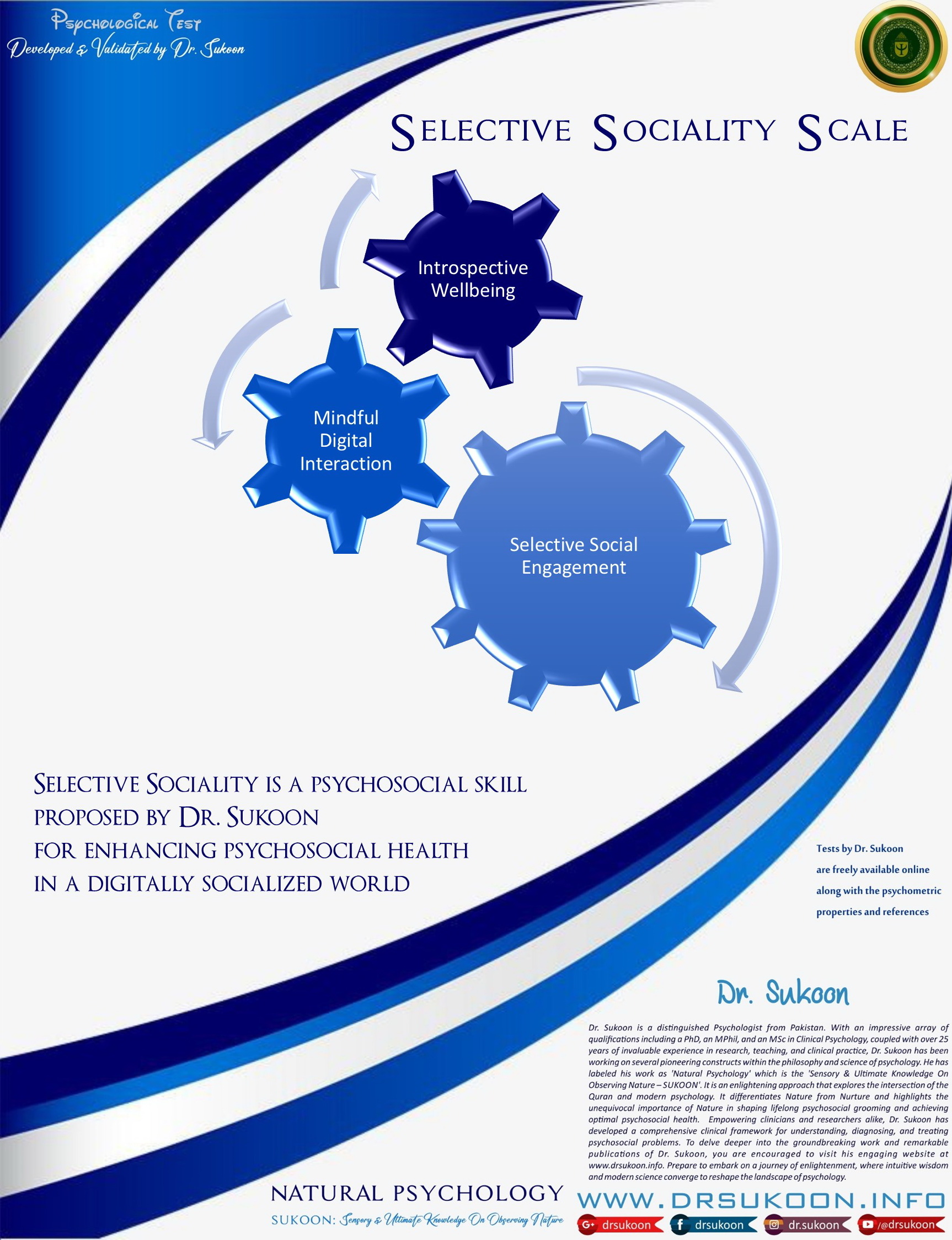
comprises three theoretically derived subscales:
Selective Social Engagement – measures the tendency to pursue
emotionally nourishing and value-congruent relationships, while
avoiding toxic, superficial, or energy-draining interactions.
Mindful Digital Interaction – assesses the intentional regulation of
digital and social media use, including the management of online
interactions, content consumption, and digital boundaries to prevent
cognitive overload and emotional disturbance.
Introspective Wellbeing – evaluates the degree to which individuals
draw on solitude, reflection, and inner awareness to maintain
psychological equilibrium and autonomy in social contexts.
By integrating dimensions of emotional intelligence, self-awareness,
and social discernment, the SSS emerges as a timely and culturally
relevant tool that addresses the psychosocial challenges of
contemporary life—particularly the overstimulation, comparison
anxiety, and attention fragmentation exacerbated by digital
hyperconnectivity. The Selective Sociality Scale holds significant
utility in clinical, organizational, educational, and developmental
contexts, where the quality—not just the quantity—of social
engagement is increasingly recognized as vital to mental health. It
aligns closely with the principles of Natural Psychology,
emphasizing adaptive behavior, psychological boundary-setting, and
self-preservative interactional strategies as essential for
achieving psychosocial health in both physical and virtual spaces.
The SSS contributes to a deeper understanding of social functioning
in the Anthropocene, where the cultivation of selective sociality
may be seen not as an exception, but as a prerequisite for
sustainable psychosocial wellness.
Instructions:
Please ensure that Scripts and ActiveX Controls are enabled in your
browser before proceeding with this electronic form.
Read each statement carefully and respond based on your immediate,
instinctive reaction. Trust your first impression.
Make sure to respond to every statement. Do not leave any item
unanswered.
This test generates your results instantly on the same page.
Therefore, do not change your responses once they are submitted, as
doing so would undermine the authenticity of your self-assessment
and reflect a lack of seriousness toward the process.
Your results are strictly confidential and cannot be accessed by
anyone else, including the administrators of this platform.
Please be honest and loyal to yourself throughout the test.
Once all items are completed, click the “Result” button to view your
scores. Interpretative guidelines are provided at the end of the
test.
Fill in the
following questionnaire |
|